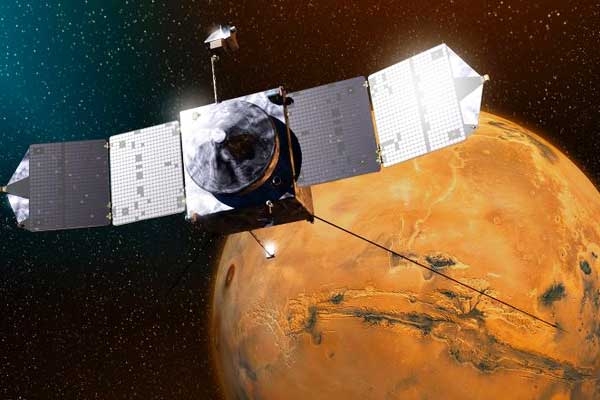
(Image source from: Twitter.com/MAVEN2Mars)
NASA has lost connection with MAVEN, a spacecraft that has been observing Mars since 2014. The Mars Atmosphere and Volatile Evolution (MAVEN) probe stopped communicating on December 6, 2025, when it went behind Mars, which is a normal part of its orbit. Although the spacecraft was functioning well before this incident, NASA could not restore communication after it came out from behind the planet. This unexpected loss of contact has raised concerns among the scientists working on the mission. On December 9, NASA reported that it is actively looking into the problem and trying to get a signal back from the probe. "NASA's MAVEN (Mars Atmosphere and Volatile EvolutioN) spacecraft, orbiting Mars, lost its signal with ground stations on Earth on December 6. Telemetry from MAVEN indicated that all systems were operational before it went behind the Red Planet. Once the spacecraft appeared again from behind Mars, NASA's Deep Space Network did not detect any signal," NASA stated in an announcement. "The teams managing the spacecraft and operations are examining the issue to resolve it. More updates will be provided when they are available," NASA added.
MAVEN, which was launched in 2013, reached Mars orbit in September 2014 to explore the upper atmosphere and how it interacts with solar wind. The mission has shown that the sun's effects caused Mars to gradually lose its atmosphere, changing the planet from a warm, wet place to the cold, dry environment it is now. MAVEN has been crucial not only for studying Mars's upper atmosphere but also for acting as a communication bridge for NASA's rovers, Curiosity and Perseverance. Its scientific findings have greatly helped us understand the Red Planet. MAVEN's data was essential in revealing how Mars lost much of its water, showing that during strong dust storms, water can rise high into the atmosphere and then be removed by solar wind. The spacecraft also contributed to mapping global wind patterns, discovered Mars's invisible magnetic "tail," and identified a process called "sputtering" which speeds up the loss of atmospheric gases. It even found a rare type of proton aurora that had not been seen on Mars before. These discoveries have enhanced our knowledge of how planets evolve, illustrating the dramatic differences in climate and habitability between Earth and Mars. MAVEN's results are also important for planning future missions to Mars.
NASA's Mars Reconnaissance Orbiter (MRO) and Mars Odyssey are still functioning, providing important data and acting as communication relays for Mars missions. MRO, which was launched in 2005, has been examining the surface and atmosphere of Mars, while Mars Odyssey, which launched in 2001, is the longest operating spacecraft at Mars, concentrating on geological and climate studies. According to NASA, the goal of Mars Odyssey is to investigate "clouds, fog and frost, and to create maps of surface rocks to make future landings on Mars safer."